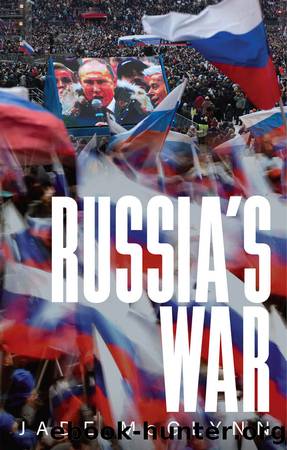
Russia's War by Jade McGlynn
Author:Jade McGlynn [McGlynn, Jade]
Language: eng
Format: azw3
ISBN: 9781509556779
Publisher: Polity Press
Published: 2023-02-27T00:00:00+00:00
This view approximates to my own. Russian insecurity exists for reasons independent of the West but Western actions have triggered and exacerbated it, even radicalised it when combined with obvious hypocrisy and what Marlene Laruelle has termed ânormative imperialismâ.30 Potential NATO candidacy for Ukraine is seen in Russia and by Russians as a symptom of the problem, not the main problem in itself, as itâs not NATO enlargement en se that matters so much as Moscowâs perception that its âownershipâ (of Eastern Europe) was being violated.31 In the Kremlinâs view, this was a US-driven effort to push traditionally Soviet or Russia-aligned states into the US sphere of influence, including through artificial regime change. US actions in Kosovo, Iraq, Libya and Syria were viewed through this prism (unlike say US intervention in Sierra Leone, not a traditional Russian ally) and led to diplomatic and even military pushback, as determined by the limits of Russian power at the time. This explanation that itâs not about NATO so much as what NATO represents, even civilisationally, explains why Russia meekly accepted Sweden and Finland joining NATO; because even if they were neutral, the Kremlin sees them as Western countries that do not belong to Russiaâs sphere of influence. Whatâs more, if NATO membership was the immediate threat, then Russia behaved entirely counterintuitively, since its occupation of Crimea and Donbas in 2014 had put an effective stop to any formal entry of Ukraine into NATO because it would have required the politically unacceptable act of Kyiv giving up its claim to these territories.
In conclusion, any discussion that centres on NATO expansion as a key driver for Russiaâs invasion and/or insecurity is simplistic. The question of Ukraineâs civilisational status is much more complex than a basic security buffer zone issue and instead goes to the heart of Russian identity, status-seeking and historical grievance. The NATO expansion question is also over-discussed compared to other Western failures to support not only Russia but other post-communist countries in terms of sociopolitical issues and even just by not facilitating the elitesâ corruption. Westerners, especially Americans, should not inflate their own countriesâ importance in determining Russian actions but, if they insist, then there is plenty of terrain to explore without having to crowd around the topic of NATO expansion. Moreover, any proper understanding of NATOâs role in aggravating tensions with Russia should not start from the allianceâs engagement with Georgia or Ukraine but rather from the Yugoslav wars, and especially the bombing of Yugoslavia in 1999 â a war that, if it is remembered at all in London or Washington, is misremembered, despite its clear relevance to the conflict unfolding in Ukraine.
Download
This site does not store any files on its server. We only index and link to content provided by other sites. Please contact the content providers to delete copyright contents if any and email us, we'll remove relevant links or contents immediately.
The Secret History by Donna Tartt(19089)
The Social Justice Warrior Handbook by Lisa De Pasquale(12190)
Thirteen Reasons Why by Jay Asher(8910)
This Is How You Lose Her by Junot Diaz(6887)
Weapons of Math Destruction by Cathy O'Neil(6281)
Zero to One by Peter Thiel(5802)
Beartown by Fredrik Backman(5754)
The Myth of the Strong Leader by Archie Brown(5508)
The Fire Next Time by James Baldwin(5446)
How Democracies Die by Steven Levitsky & Daniel Ziblatt(5219)
Promise Me, Dad by Joe Biden(5153)
Stone's Rules by Roger Stone(5088)
A Higher Loyalty: Truth, Lies, and Leadership by James Comey(4964)
100 Deadly Skills by Clint Emerson(4925)
Rise and Kill First by Ronen Bergman(4789)
Secrecy World by Jake Bernstein(4753)
The David Icke Guide to the Global Conspiracy (and how to end it) by David Icke(4720)
The Farm by Tom Rob Smith(4513)
The Doomsday Machine by Daniel Ellsberg(4490)
